

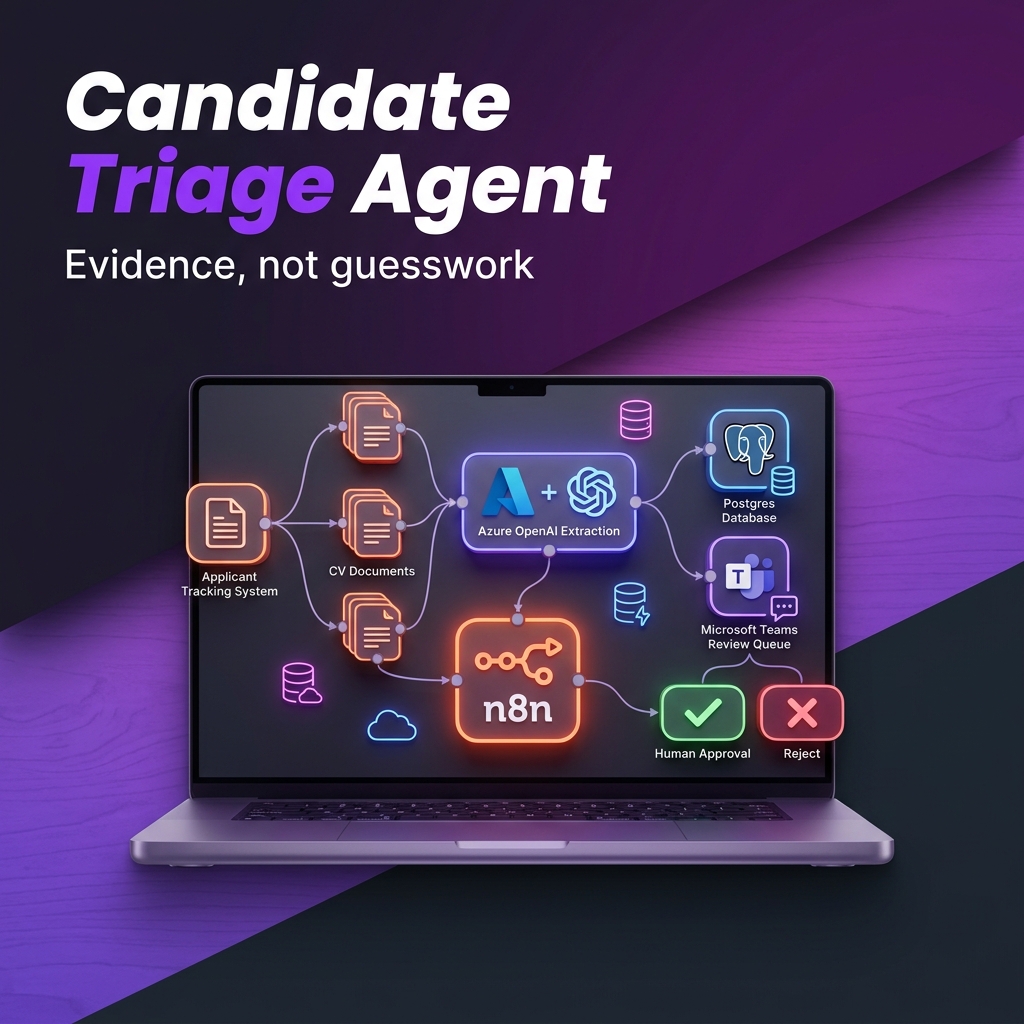
Build a Candidate Triage Agent
Recruitment AI is not failing because recruiters lack tools. It is struggling because the hiring workflow around those tools is often messy, fragmented and hard to govern.
A candidate triage agent gives hiring teams a more practical route: connect the applicant tracking system, inbox, CVs, scorecards, databases and recruiter review steps into one auditable workflow. At nocodecreative.io, this is exactly the sort of AI automation pattern we build for teams that need useful operational systems, not another isolated dashboard.
The Core Goal: The objective is not to let artificial intelligence decide who gets a job. The goal is to organise evidence, reduce repetitive screening work, highlight uncertainty, and make sure recruiters stay accountable for the final decision.
Why AI hiring tools are not delivering smarter decisions yet
Recent research reported by HR Dive found that more than 90% of surveyed organisations had used AI tools in recruiting, but fewer than 5% reported transformational outcomes across key metrics. The same research, commissioned by ManpowerGroup Talent Solutions and developed with Everest Group, drew on 80 C-suite, Chief Human Resources Officer and senior talent acquisition leaders across the United States and United Kingdom. It found that AI is mainly being used for sourcing, CV screening and candidate engagement, while improvements in decision quality remain limited. (hrdive.com)
That is the useful bit. AI adoption is not the same as hiring improvement.
The report points to fragmented systems, isolated tools and siloed data as major blockers. It also notes that candidate use of AI, including AI-generated CVs, applications and interview preparation, is making it harder to assess genuine capability. In other words, recruitment teams are facing two problems at once: too much scattered information, and more noise in the application pile. (prnewswire.com)
This is why buying another standalone screening tool often disappoints. If the Applicant Tracking System, or ATS, holds one version of the candidate, the recruitment inbox holds another, the hiring manager’s feedback sits in Microsoft Teams, and scorecards live in spreadsheets, the underlying hiring process has not been improved. It has merely acquired another login.
A candidate triage agent is different. It is a workflow layer that connects the messy middle.
The workflow opportunity: fix the fragmented middle of recruitment
A useful candidate triage agent should sit between intake and judgement. It should capture applications, extract structured information, store evidence, compare candidates against role-specific criteria, flag uncertainty, and route the right cases to recruiters and hiring managers.
This is where n8n works well. n8n can orchestrate data between systems, call Application Programming Interfaces, or APIs, run conditional logic, write to a database, send Microsoft Teams notifications, and pause for human review. n8n’s documentation includes patterns for human fallback in AI workflows, and its HTTP Request node can query services with REST APIs, which is useful when an ATS connector does not exist out of the box. (docs.n8n.io)
For the language model layer, Azure OpenAI can return structured outputs that follow a JSON Schema. JSON, or JavaScript Object Notation, is a machine-readable data format, and schema-based outputs make the model’s response easier to validate and store. Microsoft’s documentation describes structured outputs as a way to make a model follow a JSON Schema for extraction, function calling and multi-step workflows. (learn.microsoft.com)
The resulting architecture is not magic. It is plumbing, prompts, permissions and process design. Glamorous in the same way a well-labelled fuse box is glamorous, which is to say quietly essential.
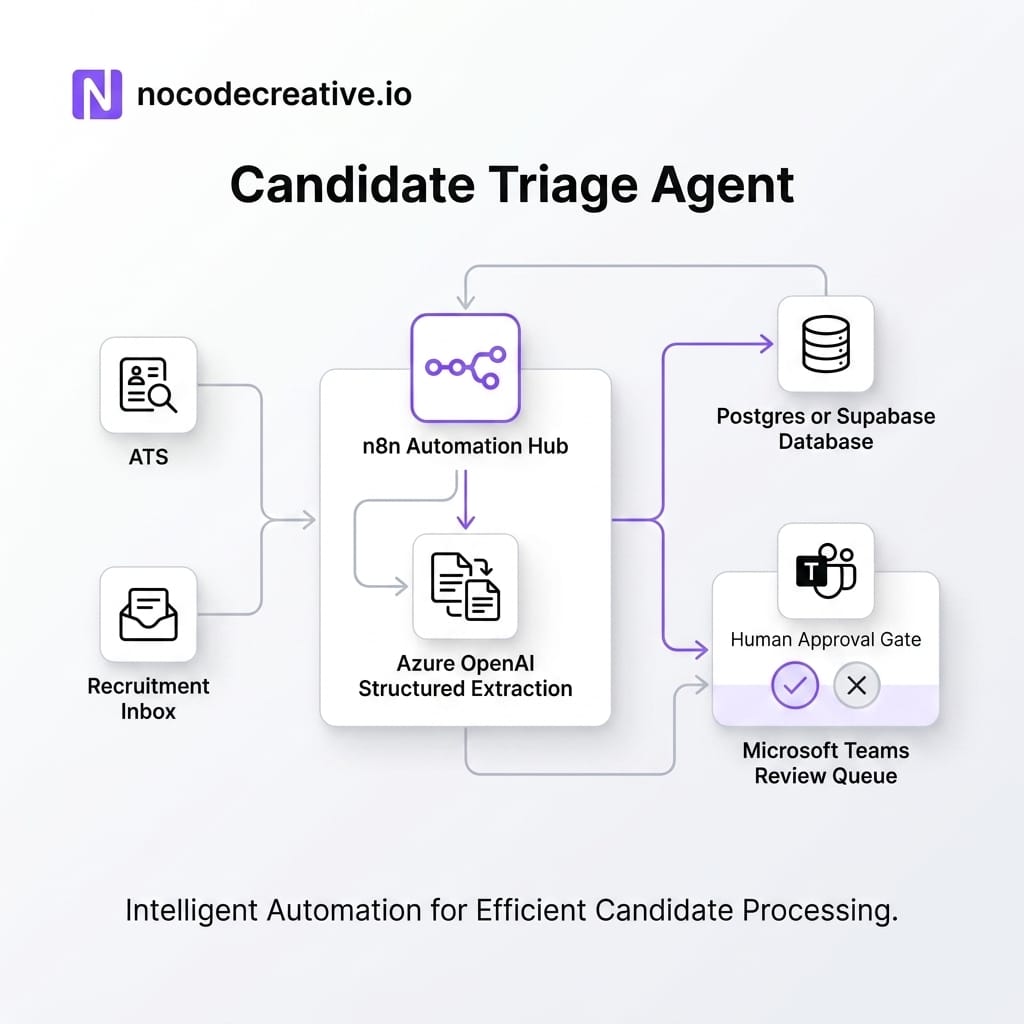
Reference architecture for a candidate triage agent
A practical candidate triage agent has seven main layers.
The first layer is intake. This might be a Greenhouse, Lever, Workday or Ashby webhook, a shared Outlook or Gmail recruitment inbox, a website form, or a scheduled export from an ATS. The workflow watches for new applications and pulls together the CV, cover letter, answers to screening questions, source, role ID and consent metadata.
The second layer is document extraction. CVs arrive as PDFs, Word documents and occasionally something more creative. The workflow extracts the text, stores the original file securely, and records where each piece of evidence came from.
The third layer is structured AI extraction. Azure OpenAI receives the extracted text and returns a predictable candidate profile, such as contact details, work history, skills, qualifications, certifications, notice period, location preferences and evidence snippets. The key is to ask for evidence, not just conclusions.
The fourth layer is storage. n8n’s Postgres node supports inserting, updating and querying rows in a Postgres database, making it a natural fit for candidate records, scorecard outputs and audit events. Supabase can also be used when you want Postgres with application-friendly features, and its documentation supports vector columns through pgvector where similarity search is needed. (docs.n8n.io)
The fifth layer is role-fit scoring. The system compares each candidate against must-have, nice-to-have and disqualifying criteria supplied by the hiring manager. It should produce a scorecard with rationale, confidence and linked evidence. A low score without evidence is not useful. A high score without evidence is worse, because it looks convincing.
The sixth layer is human review. n8n can send candidate summaries to Microsoft Teams using its Teams node, which supports messages, channels and tasks. Microsoft Copilot Studio can also pause agent flows to request information from human reviewers before continuing, which is a useful equivalent pattern for organisations already standardised on Power Platform. (docs.n8n.io)
The seventh layer is audit and sync. Outcomes, reviewer actions, reasons, prompt versions and workflow execution logs are written back to the candidate database and, where appropriate, the ATS as the system of record.
Capture applications from ATS, inboxes or forms
Start with intake, because this is where many recruitment automation projects become untidy.
For SMEs, the first version may simply monitor a shared recruitment inbox and a web form. For larger teams, the better route is usually an ATS webhook or API integration. Either way, the n8n workflow should create a single candidate intake record with a stable candidate ID, role ID, source and timestamp.
At this stage, do not ask the AI model to make hiring judgements. Keep the first workflow boring and reliable. It should download documents, save originals, extract plain text, check for duplicate emails or phone numbers, and create an initial status such as “received”, “extraction complete” or “requires manual document review”.
Data Protection Notice: This is also where data protection starts. CVs contain personal data, and sometimes special category data by inference, such as disability-related information, ethnicity, age or health details. UK and European teams should treat recruitment AI as a data protection project as well as an automation project.
Extract CV and application data into a structured schema
Once the application is captured, the next job is to turn messy text into structured data. A well-defined structured schema typically captures the candidate's name, contact details, and location alongside their comprehensive employment history—including current and previous employers, role titles, dates, and any employment gaps.
Beyond the basics, the schema should systematically extract skills, tools, qualifications, certifications, and licences. Where lawful and appropriate, it can also verify right-to-work or work authorisation status. Crucially, a robust extraction process requires evidence snippets linked directly to the original CV or application answers, while explicitly flagging missing information and assigning an extraction confidence score.
Azure OpenAI structured outputs are helpful because they reduce the need for fragile text parsing. Instead of asking the model for a paragraph summary and hoping another step can interpret it, the workflow asks for defined fields in a predictable format. Microsoft’s guidance also includes examples for entity extraction using structured outputs, which aligns well with CV parsing and candidate profile normalisation. (learn.microsoft.com)
The important design choice is to separate extraction from evaluation. “This candidate has five years of Python experience according to role X at employer Y” is an extraction. “This candidate should be shortlisted” is an evaluation. Mixing the two makes the workflow harder to audit.
Store candidate evidence in Postgres or Supabase
A candidate triage agent needs a proper evidence store. A spreadsheet can work for a proof of concept, but it becomes fragile once you add multiple roles, hiring managers, retries, status changes and compliance review.
Modern databases like Postgres or Supabase are ideal for securely housing structured candidate profiles alongside role criteria, extracted evidence, and scorecard results. Additionally, they serve as the operational backbone of the system by meticulously logging duplicate detection hashes, reviewer decisions, prompt and schema versions, and comprehensive workflow execution logs.
This database does not need to replace the ATS. In most organisations, the ATS should remain the system of record for formal recruitment status. The triage database is the operational layer that makes the process explainable and searchable.
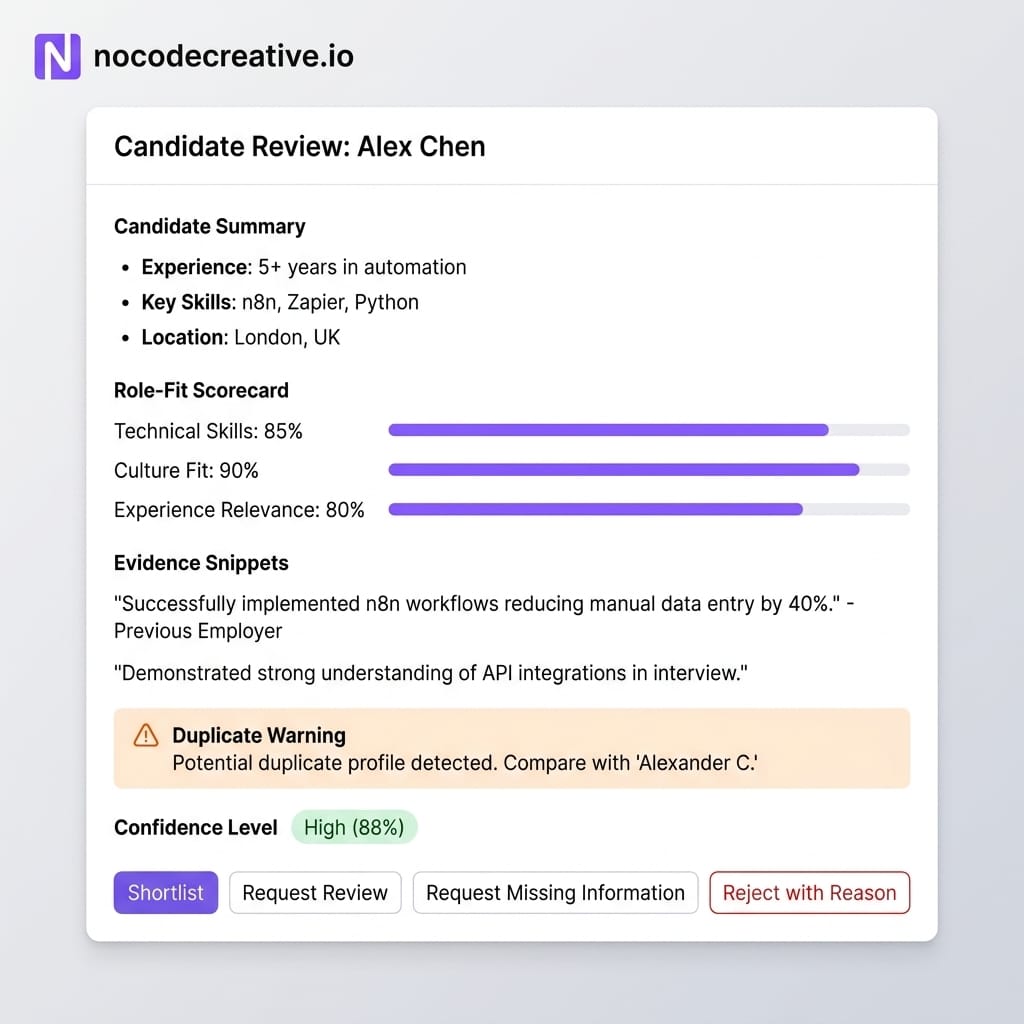
For example, if a recruiter asks why someone was flagged as a strong match, the answer should not be “the model thought so”. It should show the relevant must-have criteria, evidence snippets from the CV, confidence level, reviewer action and timestamp.
This is where an experienced implementation partner can save a lot of rework. Our AI automation and n8n implementation services focus on building the connective tissue between business systems, databases and human workflows, so teams are not left with a clever demo that nobody trusts in production.
Score candidates against transparent role-specific criteria
The scoring layer should start with hiring-manager criteria, not a generic prompt.
A good role scorecard separates must-have criteria from nice-to-have criteria and disqualifying criteria. For example, a finance operations role might require advanced Excel, month-end close experience and UK payroll exposure. A nice-to-have might be Power BI, while a disqualifier might be lack of required work authorisation for that specific role.
Once criteria are set, the model compares the structured candidate profile against each point to return a comprehensive assessment. This evaluation clearly defines the match status alongside linked evidence and detailed rationale. It also calculates a confidence score, flags any missing information, and provides a suggested human review reason for the recruitment team.
This should be positioned as triage, not automated rejection. High-confidence matches can be routed to a shortlist for recruiter review. Low-confidence cases, unusual backgrounds and missing information should go to a human queue. Candidates should not be automatically rejected purely because an LLM, or Large Language Model, gave them a low score.
This matters legally and ethically. In the United States, the Equal Employment Opportunity Commission, or EEOC, warns that tests and selection procedures can violate federal anti-discrimination laws if they disproportionately exclude protected groups unless properly justified. The EEOC has also warned that AI tools used to score CVs or assess applicants can create risks under the Americans with Disabilities Act. (eeoc.gov)
Detect duplicates, missing information and application noise
Recruitment teams are now dealing with a signal-quality problem. Some candidates apply multiple times with different CVs. Some use AI-generated cover letters that sound polished but say very little. Some applications are incomplete, while others include inconsistencies between the CV, screening answers and interview notes.
A triage agent can help here without becoming punitive.
The workflow can use deterministic checks, such as matching email addresses, phone numbers and document hashes. It can use database similarity checks to detect near-duplicate CVs. It can also ask an LLM to summarise inconsistencies, but the output should be a recruiter-facing flag rather than a decision.
A sensible risk flag might say: “The candidate’s CV lists five years of Salesforce experience, but the application answer states one year. Please review before scoring CRM experience.”
That is useful. “Reject candidate for inconsistency” is not.
Route decisions to recruiters with human-in-the-loop rules
The review queue is where the workflow becomes operational.
A Microsoft Teams card can show the candidate summary, role-fit scorecard, evidence snippets, missing information, duplicate flags and suggested next action. The recruiter or hiring manager can choose shortlist, reject with reason, request more information, escalate to compliance, or override the AI recommendation.
n8n can then capture that action, update the candidate database, notify the recruiter, and optionally sync a status change back to the ATS. Microsoft Teams is useful because hiring managers already live there, and n8n’s Teams node can integrate Teams with other applications. (docs.n8n.io)
For Microsoft-first organisations, Copilot Studio and Power Platform can provide similar human review patterns. Microsoft’s request information action can pause an agent flow, collect input from designated reviewers and use that input in later steps. (learn.microsoft.com)
The key phrase is meaningful human review. A human who rubber-stamps every AI suggestion is not a meaningful control. Reviewers need enough context, authority and time to challenge the recommendation.
Sync outcomes back to the ATS and build an audit trail
A candidate triage agent should not create a shadow recruitment process. Once a recruiter has reviewed the recommendation, the outcome should sync back to the ATS where appropriate.
For example, the workflow might update a custom field, add a private note, change a candidate stage, or attach the scorecard summary. If the ATS API is limited, the workflow can still create a structured summary for recruiters to paste or approve manually.
The audit trail should include the original application timestamp, extraction version, prompt version, scoring rubric, model output, reviewer action, reason codes and final sync status. This protects the organisation and improves the process over time.
It also makes reporting far easier. You can start to answer questions such as where strong candidates are being lost, which roles generate the most incomplete applications, which criteria cause most escalations, and how often recruiters override AI recommendations.
If you want to see how this sort of operational system thinking applies outside recruitment, our festival operations automation case study shows how replacing manual tracking with structured workflows, databases and real-time reporting can create a more reliable operating model.
Governance checklist for fairness, explainability and privacy
Recruitment is a high-stakes domain, so governance cannot be an afterthought.
In the UK, the Information Commissioner’s Office, or ICO, has made automated decision-making in recruitment a regulatory focus. Its 2026 update found that many employers using automated recruitment systems may be relying on solely automated decisions without meaningful human involvement, bringing them within UK GDPR provisions on solely automated decision-making. The ICO also highlighted transparency, safeguards, fairness, bias monitoring and Data Protection Impact Assessments, or DPIAs, as key areas for employers. (ico.org.uk)
In the European Union, AI systems used for recruitment or selection of natural persons may be classified as high-risk under the EU AI Act, particularly where they rank, filter or shortlist candidates. The European Commission’s AI Act Service Desk gives examples of recruitment ranking and applicant scoring systems that may fall within high-risk employment use cases. (ai-act-service-desk.ec.europa.eu)
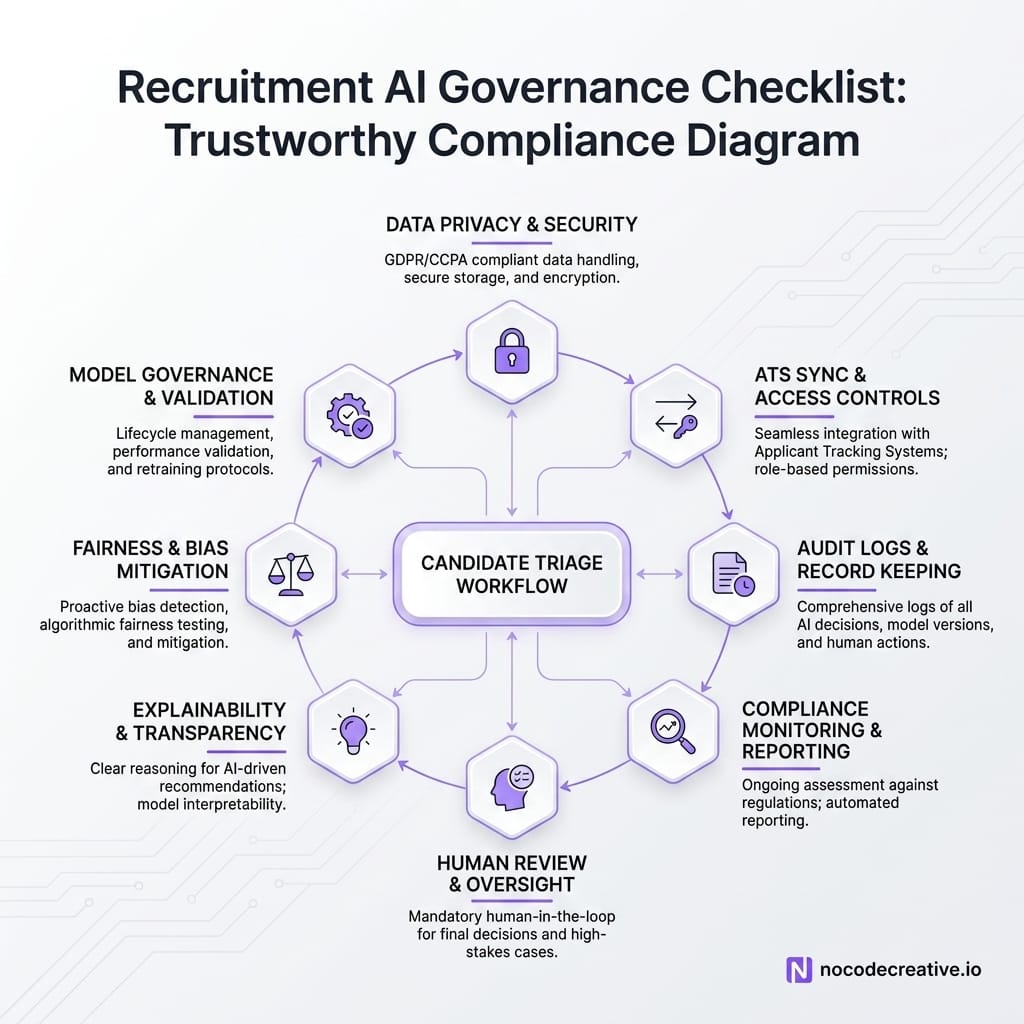
For practical purposes, your governance framework must cover multiple legal and operational touchpoints. Begin with clear candidate notices explaining AI-assisted processing and ensure a defined lawful basis under UK GDPR or EU General Data Protection Regulation. Strict data minimisation is essential so only relevant recruitment data is processed.
Operationally, rely exclusively on role-specific criteria approved by hiring managers, and implement ongoing bias and adverse impact monitoring. Ensure there is mandatory human review for consequential decisions, alongside tight prompt and rubric version control.
Administratively, establish robust access controls and retention policies, complete a DPIA before production use, and provide a clear, documented route for candidates to request human intervention or contest significant decisions.
This framework is not there to slow the team down. It is there to make the workflow usable in the real world.
Fast-start implementation plan for SMEs and enterprise teams
For an SME, the first useful version can be built in weeks rather than months. Start with one role family, one intake channel and one recruiter review queue. Use n8n to capture applications, Azure OpenAI to extract structured candidate profiles, Postgres or Supabase to store evidence, and Teams to route review cards.
Keep the scorecard simple. Five must-have criteria, five nice-to-have criteria and a clear escalation rule are enough for a pilot. Measure recruiter time saved, review quality, missing information rates and override frequency. Avoid claiming the workflow has improved hiring quality until you have enough evidence.
For enterprise teams, start with governance and integration boundaries. Decide whether the ATS remains the only system of record, which data can be processed by Azure OpenAI, where logs are retained, who owns the scoring rubric, and how compliance reviews will happen. You may also need separate development, staging and production environments for n8n, with credentials, audit logs and access controls properly managed.
Mid-sized and enterprise teams often benefit from a design sprint before implementation. Our automation case studies and implementation examples show the kind of practical workflow thinking that helps turn scattered processes into systems people can actually run.
Where an implementation partner adds value
The hard part of a candidate triage agent is not calling an AI model. It is designing the workflow so that recruiters trust it, compliance teams can review it, hiring managers use it, and candidates are treated fairly.
An implementation partner can help define the architecture, build the n8n workflows, connect ATS APIs, design structured Azure OpenAI schemas, create Postgres or Supabase records, configure Teams review queues, implement retry logic, manage prompt versions, build dashboards and document the governance model.
The best version of this system should feel boring in daily use. Applications arrive, evidence is organised, uncertainty is flagged, reviewers act, the ATS is updated, and the audit trail quietly records what happened. Recruiters get time back without losing control. Hiring managers get cleaner shortlists. Compliance teams get visibility. Candidates get a process that is easier to explain.
That is the point of a candidate triage agent: not replacing judgement, but making judgement easier to apply consistently.
Our expert AI consultants can help you implement these workflows. Get in touch to discuss your automation needs.
References
- • HR Dive: Broken recruiting processes block AI gains, survey shows
- • ManpowerGroup: 90% of Companies Use AI in Hiring. Fewer Than 5% Are Seeing It Work
- • n8n Docs: Set a human fallback for AI workflows
- • n8n Docs: HTTP Request node
- • n8n Docs: Postgres node
- • n8n Docs: Microsoft Teams node
- • Microsoft Learn: Azure OpenAI structured outputs
- • Microsoft Learn: Request information from human review in agent flows
- • Supabase Docs: Vector columns
- • EEOC: Employment Tests and Selection Procedures
- • ICO: Recruitment rewired, responsible use of automation in recruitment
- • European Commission AI Act Service Desk: Employment



Discussion