


Claude Opus 4.5 in real life: turning Opus and Sonnet into serious enterprise workflows
Anthropic’s Claude 4.5 family has moved to something teams can really build around, especially if you care about coding, agents, spreadsheets, and slide decks at scale.
At nocodecreative.io, this is exactly the layer we live in: taking models like Claude Opus 4.5 and Sonnet 4.5 and wiring them into reliable n8n, Azure, and Power Platform workflows that real businesses can depend on.
In this guide we will stay away from benchmark charts and focus on how to turn Claude 4.5 into working systems for development, finance, consulting, and operations teams, while keeping an eye on safety, cost, and governance.
Why Claude Opus 4.5 matters now for builders and operations leaders
Claude 4.5 is interesting not because it is slightly better on a leaderboard, but because its capabilities line up with the type of work many organisations already do every day. Rather than just asking questions, it handles:
Complex Codebases
Handling ongoing refactors and tests across large repositories.
Spreadsheet Modelling
Performing never‑ending variance analysis and data reconciliation.
Strategic Decks
Creating client and board decks that must be accurate and on‑brand.
Ops Monitoring
Cross‑system monitoring that typically lives only in someone’s head.
Anthropic positions Opus 4.5 as its most capable model, focused on the hardest reasoning and analysis, and Sonnet 4.5 as its best coding and agentic workhorse (platform.claude.com). Together with Haiku 4.5, which is tuned for low cost and fast responses, this creates a practical tiered stack for enterprise workflows (anthropic.com).
The Leadership Shift: The goal is moving from “ask a chatbot some questions” to “hand an end‑to‑end task to an AI agent and review the output”.
Anthropic’s position in the enterprise AI market
Anthropic has leaned heavily into the enterprise side of AI:
- Cloud availability: Claude 4.5 models are available via Anthropic’s own API, Amazon Bedrock, Google Cloud Vertex AI, and increasingly through Microsoft platforms. (aws.amazon.com)
- Agent capabilities and tooling: Sonnet 4.5 is optimised for long‑running coding and agentic workflows, featuring better tool use, memory management, and context handling. (platform.claude.com)
- Safety and alignment: Released under Anthropic’s AI Safety Level 3 controls, it is marketed as the “most aligned frontier model yet”, with protections for agentic use. (anthropic.com)
This makes Claude 4.5 a solid fit for multi‑vendor AI strategies. Many organisations are already invested in OpenAI inside Microsoft 365, so adding Anthropic via Bedrock, Vertex AI, or Azure simply broadens the toolkit rather than replacing anything.
If you are designing an enterprise AI stack, this is where a partner like nocodecreative.io can help you design an architecture that keeps the benefits of Microsoft Copilot and similar tools while adding specialised Claude‑powered automations and n8n workflows that sit around them.
Understanding the Claude 4.5 family
The Claude 4.5 line‑up splits neatly into three: Opus 4.5, Sonnet 4.5, and Haiku 4.5. Each plays a different role in a real workflow.
Opus 4.5: Deep reasoning and high‑stakes work
Opus 4.5 is described as the “most intelligent” model, with step‑change improvements in reasoning. In practice, you reserve Opus 4.5 for work that you would otherwise send to a senior engineer or analyst: complex refactors, multi‑sheet financial models, or board‑level narratives that must be right.
Key Features:
- Effort parameter: Trade off reasoning depth against token usage.
- Improved computer use: Includes zoom actions for UI automation.
- Thinking continuity: Preserves “thinking blocks” across multi-step tasks.
Sonnet 4.5: The coding and automation workhorse
Sonnet 4.5 is tuned for production agent use. It offers state-of-the-art performance on coding benchmarks like SWE-bench Verified and better planning for security practices. For most n8n workflows, Azure Functions, or Power Automate flows, Sonnet 4.5 is the default model you choose.
Where Haiku 4.5 fits
Haiku 4.5 is optimised for low cost and speed. In workflow design terms, Haiku is often your “fast filter” or sub‑agent, Sonnet is your main worker, and Opus is your specialist consultant.
Core capabilities that change day‑to‑day work
Production‑grade code generation
Sonnet 4.5 and Opus 4.5 shine when you go beyond a “chat about code” and tie Claude directly into your repositories. Plugged into CI/CD, this looks like parsing feature tickets, proposing implementation plans, and opening pull requests tagged to human reviewers.
Spreadsheet modelling for finance
Finance and ops teams can now upload raw GL, CRM, and billing exports and have an agent clean, join, and model the data in Excel. The output includes scenario tabs and linked sheets, wrapped in a controlled workflow rather than a one‑off upload.
Slide and document workflows
Between Opus and Sonnet, you can take messy research inputs—clustered insights, transcripts, notes—and turn them into structured narratives. This includes slide outlines with speaker notes and auto-populated PowerPoint templates, aiming for a deck that arrives 70-80% “client ready.”
Designing practical workflows on n8n, Azure, and Power Platform
Now to the part that actually matters: patterns that you can implement.
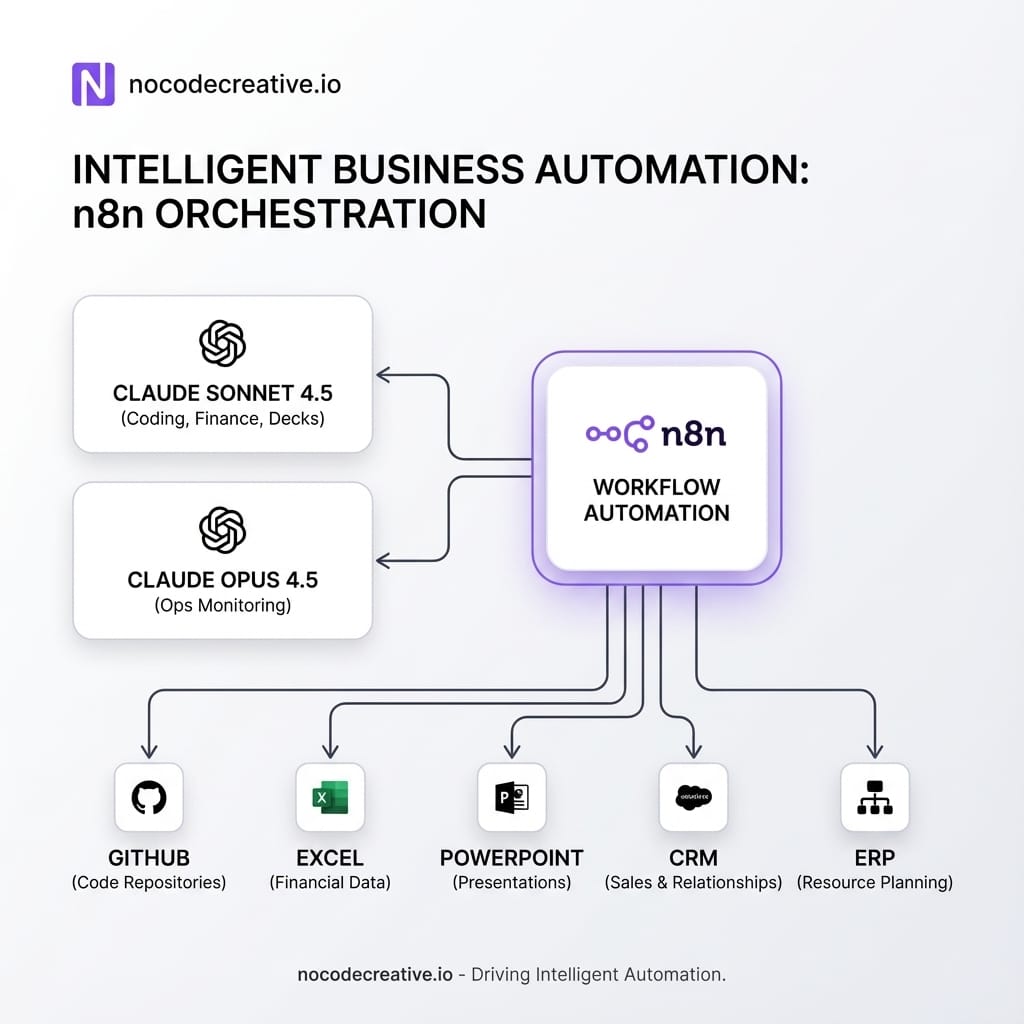
Pattern 1 – Repo‑aware coding pipelines
For IT and Engineering Teams
- A developer submits a feature or refactor request via GitHub Issues or Azure DevOps.
- n8n triggers on the issue, pulls recent commits and relevant files, and builds a context bundle.
- Sonnet 4.5 (via Bedrock/Vertex/API) generates a design proposal, implementation steps, and candidate patches.
- For deep or risky changes, n8n upgrades the request to Opus 4.5 for a second‑pass review.
- The workflow opens a pull request, tags reviewers, and logs metrics.
See our n8n automation services for practical examples.
Pattern 2 – Finance and FP&A copilots
For Finance and Operations Teams
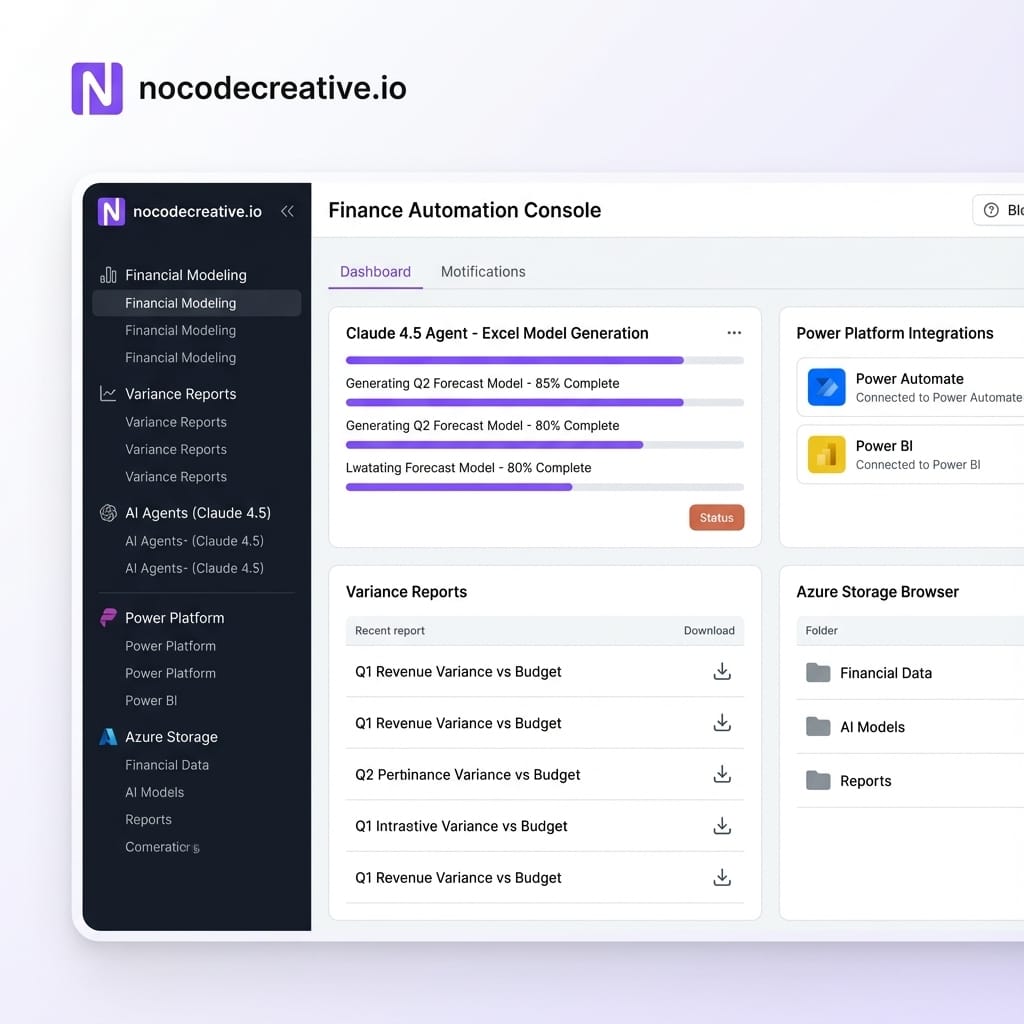
- Finance exports monthly data (GL, CRM, billing) into secure storage (Azure Blob, OneDrive, S3).
- Power Automate triggers an Azure‑hosted agent built around Opus 4.5 and Sonnet 4.5.
- The agent joins/cleans data, flags anomalies, and asks clarifying questions.
- It generates linked Excel models with base, upside, and downside scenarios.
- Sonnet 4.5 drafts a narrative variance analysis and a short slide pack for leadership.
Learn more about our AI agents for operations and finance.
Pattern 3 – Deck‑building factories
For Consulting and Strategy Teams
- Project teams drop discovery notes and transcripts into SharePoint/OneDrive.
- Sonnet 4.5 clusters insights; Opus 4.5 handles tricky synthesis.
- Models propose storyline options and generate slide outlines with speaker notes.
- A final step applies a PowerPoint template using Office Scripts, leaving consultants to refine.
Pattern 4 – Cross‑system ops monitoring
For Operations Leaders
- n8n runs on a schedule, pulling data from CRM, ticketing, and finance APIs.
- Sonnet 4.5 reviews KPIs, flags anomalies, and digests for Slack/Teams.
- Opus 4.5 produces root‑cause summaries for complex weekly narratives.
- The agent triggers pre-approved remediation actions (e.g., email sequences).
If you want help building any of these patterns, our team at nocodecreative.io offers end‑to‑end AI workflow implementation across n8n, Azure, and Power Platform so you do not have to assemble all of this in‑house.
Architecture, guardrails, and quota management
All of this power can easily turn into chaos if you do not design the plumbing properly.
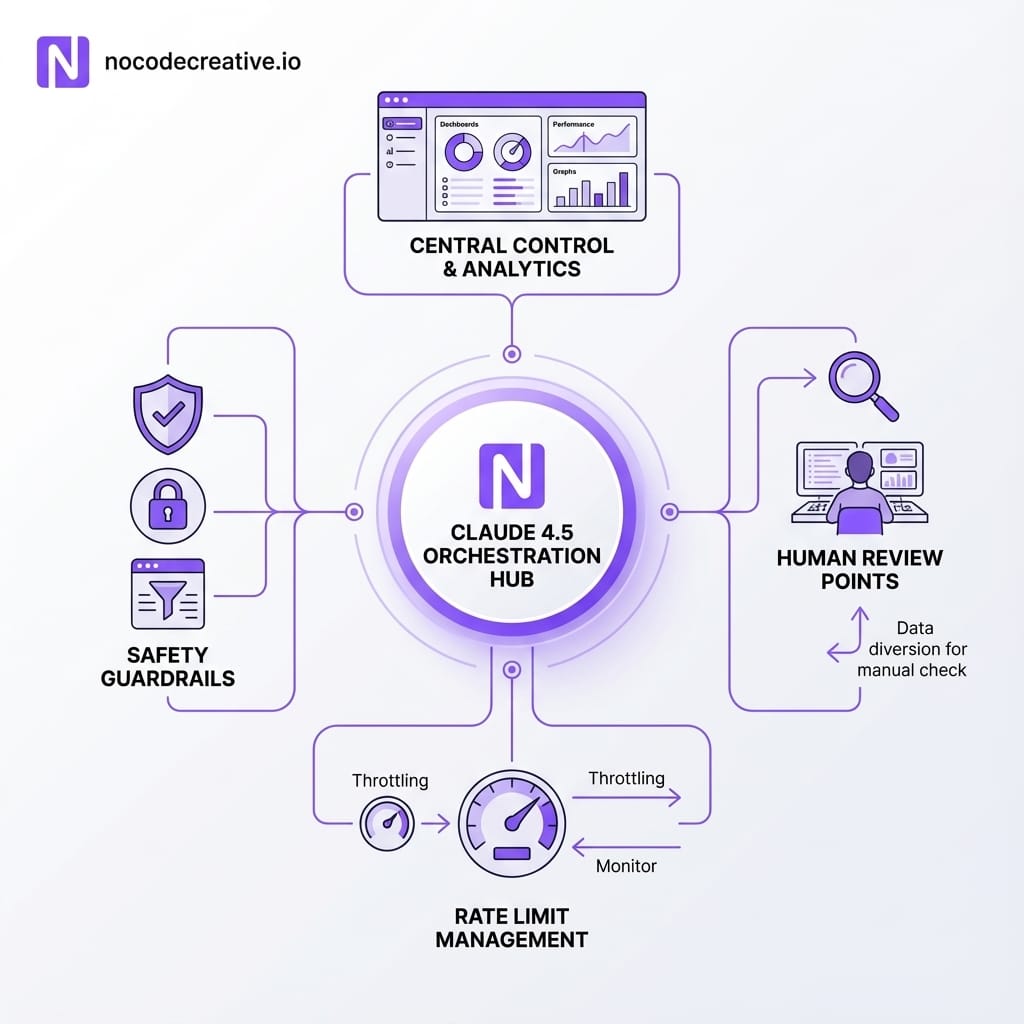
When to use Sonnet vs Opus (and how to mix them)
A practical rule of thumb:
- Haiku 4.5 for fast filters, classification, and cheap pre‑processing.
- Sonnet 4.5 for most coding, automation, and business document tasks.
- Opus 4.5 for senior specialist work: complex refactors, difficult models, or high‑stakes analysis.
In n8n or Azure, you encode this logic by switching to Opus only for "critical" tasks or low-confidence outputs, and falling back to Sonnet/Haiku if limits are hit.
Handling rate limits, cost controls, and fallbacks
Claude 4.5’s long context capabilities create cost and rate‑limit risks. We typically implement:
- Context trimming: Using embeddings to pass only relevant sections.
- Effort parameter tuning: Using low/medium effort for routine Opus work.
- Dashboards: Breaking down token usage by workflow and client.
- Multi-model fallbacks: Automatically backing off to Sonnet if Opus is busy.
Safety, alignment, and human‑in‑the‑loop review
In enterprise workflows, the model's safety isn't enough. We add Role-based access control via Azure AD, mandatory human checkpoints for sensitive actions, red-teaming to probe for failures, and strict audit trails of all prompts and responses.
Implementation roadmap for SMEs and mid‑market enterprises
Days 0‑30: Discovery and design
Map current processes. Identify 2-3 candidate workflows with clear pain points. Decide on your hosting (Bedrock, Vertex, etc.) and set initial guardrails.
Days 31‑60: Prototypes and controlled pilots
Build prototypes in n8n/Azure. Keep humans in the loop for every output. Instrument tracking for latency and cost. Iterate on prompts and routing.
Days 61‑90: Harden and expand
Promote successful prototypes to production. Introduce automation where reliable. Document success in your internal AI playbook.
This follows the roadmap from our AI workflow implementation projects.
Measuring ROI
To justify the expansion, track time saved per task, error rate reduction (defects, recon errors), cycle times, and qualitative decision quality from leadership feedback.
How we can help: from prototype to production
Claude Opus 4.5 and Sonnet 4.5 provide impressive raw capability, but value only appears when you embed them into the tools and processes your teams already use.
We specialize in:
- Architecture & Discovery: Designing multi-vendor AI stacks.
- Pilot Builds: Wrapping Claude in safe pipelines via n8n & Azure.
- Data Foundation: Cleaning data flows and standardizing templates.
Making Claude 4.5 part of your stack is mostly a design problem, not a model problem.
Get in touch regarding automation
References
- Introducing Claude Opus 4.5
- Introducing Claude Sonnet 4.5
- What’s new in Claude 4.5 models
- Claude Sonnet 4.5 in Amazon Bedrock
- Claude Opus 4.5 on Vertex AI

 Wayne Simpson
 Wayne Simpson


Discussion