
From manual tweaks to AI-powered campaign automation
Most paid media teams are still babysitting ad accounts that no longer need to be babysat.
Across TikTok, Google and Meta, AI-powered campaign automation is already handling huge chunks of targeting, bidding and creative delivery. Products like TikTok Smart+, Google Performance Max and Meta Advantage+ Shopping campaigns use machine learning to decide who sees what, where and when, in real time (newsroom.tiktok.com).
The gap is that many organisations still treat these as slightly smarter manual campaigns, rather than as part of an integrated acquisition system with proper workflow automation, data architecture and feedback loops.
At nocodecreative.io, this is exactly the layer we build. We combine AI-powered campaign automation with tools like n8n, Microsoft Power Automate and Azure so that media buying, reporting and lead handling become a semi-autonomous system, not a pile of tabs and spreadsheets.
This guide walks through what modern AI campaign automation actually does, how to structure it, and how to turn it into a practical, almost hands-off acquisition engine for your team.
Why manual optimisation no longer keeps up
Paid media used to be about lots of small, repeated decisions. Adjust a bid here, test a new audience there, rotate a couple of creatives. That approach struggles once platforms start ingesting more signals and users than any human can reasonably track, inventory spreads across dozens of placements, and creative needs to update at the pace of culture rather than quarterly campaigns.
TikTok’s recent NewtonX research shows how advertisers are thinking about this shift. Nine in ten advertisers and executives expect AI‑driven automation to help drive growth, and 93% believe it will improve their own job performance. Yet only around one fifth say they have fully integrated AI into their core operations (newsroom.tiktok.com).
Performance at Scale
At the same time, platforms are publishing hard performance numbers that are difficult to ignore:
- TikTok reports that advertisers using Smart+ Web Campaigns to optimise for value have seen over 50% improvements in return on ad spend.
- Meta’s Advantage+ Shopping campaigns tests showed an average 12% lower cost per purchase compared with business-as-usual campaigns.
- Google’s Performance Max campaigns automatically allocate budget across Search, YouTube, Display, Discover, Maps and Gmail to maximise conversions.
The pattern is clear. The value is increasingly in setting the right objectives, signals and guardrails, then letting platform AI run the day-to-day trading. The real opportunity for your team is in the system that surrounds those campaigns: measurement, workflow, lead handling and feedback.
What AI-powered campaign automation actually does
Let us strip away the branding and look at what these systems are doing under the hood.
TikTok Smart+
TikTok Smart+ is positioned as a performance automation solution. You give it creative assets, budget and campaign goals, and it automates targeting, bidding and creative selection across multiple objectives such as Web, Catalog, App and Lead Generation campaigns. It can also tap into TikTok’s Symphony AI creative tools to generate and optimise creative variants.
In practice, that means you are no longer constructing long lists of interest audiences or detailed bid strategies.
Google Performance Max
Performance Max is Google’s cross‑channel AI campaign type. Rather than building separate campaigns for Search, Display, YouTube and so on, you provide a goal (like conversions), a budget, asset groups containing text and media, and conversion tracking signals.
Google’s AI then decides which combinations of placements and creatives should show to which users to hit your goal, using signals such as intent, audience lists and real‑time auction data.
Meta Advantage+ Shopping
Advantage+ Shopping campaigns similarly reduce manual targeting and ad set management. You provide your catalogue, creative, budget and geo constraints. Meta’s machine learning then automates audience discovery, creative combination (testing up to 150 variations), and budget allocation.
Across all three platforms, your role moves from constant micro-adjustments to defining business outcomes, providing rich signals, supplying a strong pool of creative assets, and ensuring post-click actions are measured.
Designing campaign structure that gives AI room to work
You can have the smartest AI bidding models available and still end up with mediocre performance if your campaign structure starves them of signal or boxes them into strange constraints.
Objectives, signals and conversion quality
Start with a clear, business-aligned objective for each campaign. If revenue is your north star, then simply optimising for website visits or lead form submissions will only get you so far.
For AI-powered campaign automation to work properly, you need reliable conversion tracking for outcomes you care about, sufficient volume so the algorithm can learn (dozens of conversions per week), and high-quality events weighted by value.
This is where closed-loop tracking becomes critical. If you are feeding TikTok, Google or Meta only top-of-funnel events, they will find the cheapest way to generate more of those, not necessarily more revenue.
Creative variety and testing at scale
All three platforms work best when they can test a range of creatives. Rather than one or two hero assets per ad set, think in terms of creative banks: multiple hooks for the same product, variants tailored to different stages of intent, and treatments for short video versus static. Your job becomes feeding that pool and then using your reporting layer to understand which concepts are winning.
Guardrails: budgets, placements and brand safety
“Let the AI run” does not mean “leave it entirely unsupervised”. Guardrails include budget caps, negative placements, frequency capping, and geo restrictions. Think of this as designing lanes on the motorway; you want the algorithm to have room to move, but not to veer off into traffic you cannot serve.
Turning AI-optimised campaigns into a hands-off acquisition engine
Once AI is handling most of the in-platform optimisation, the real leverage comes from how you connect those platforms to the rest of your stack. This is where tools like n8n and Power Automate sit in the middle as the operational layer.
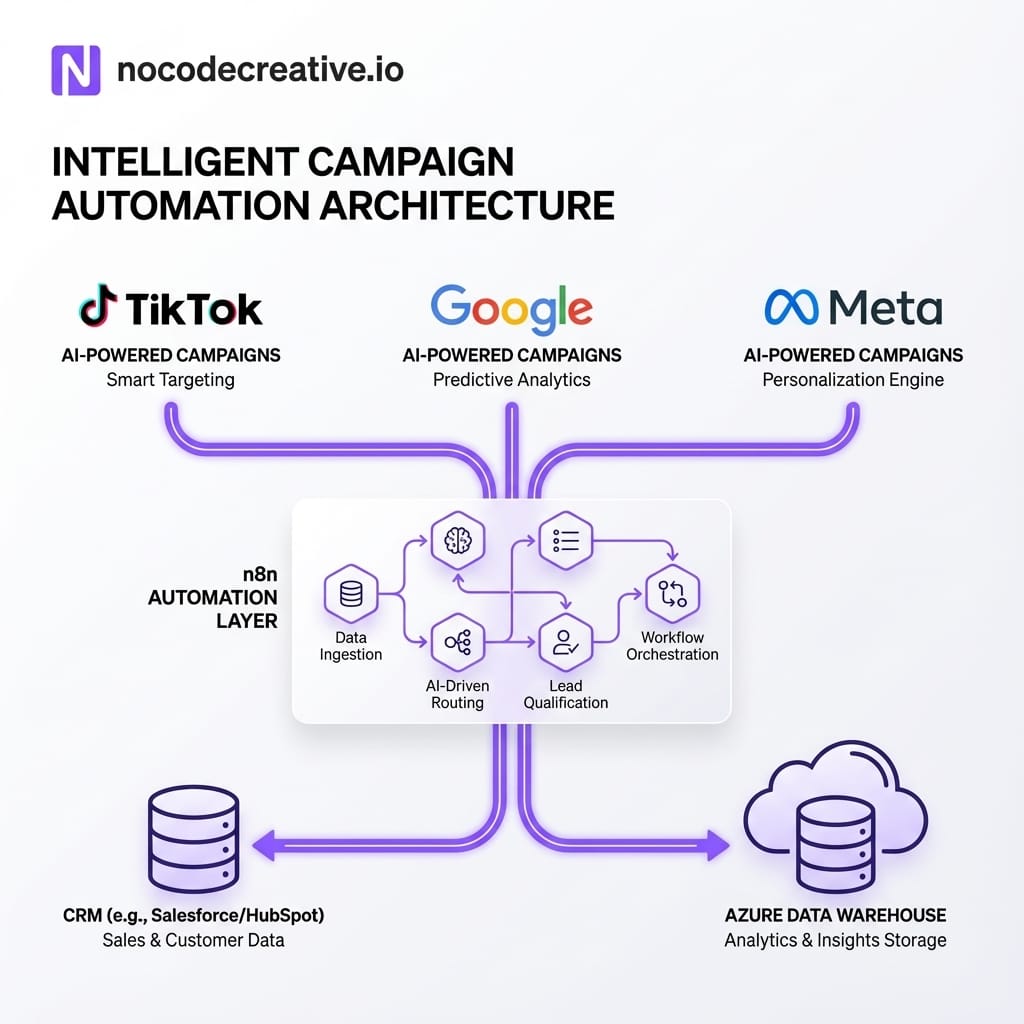
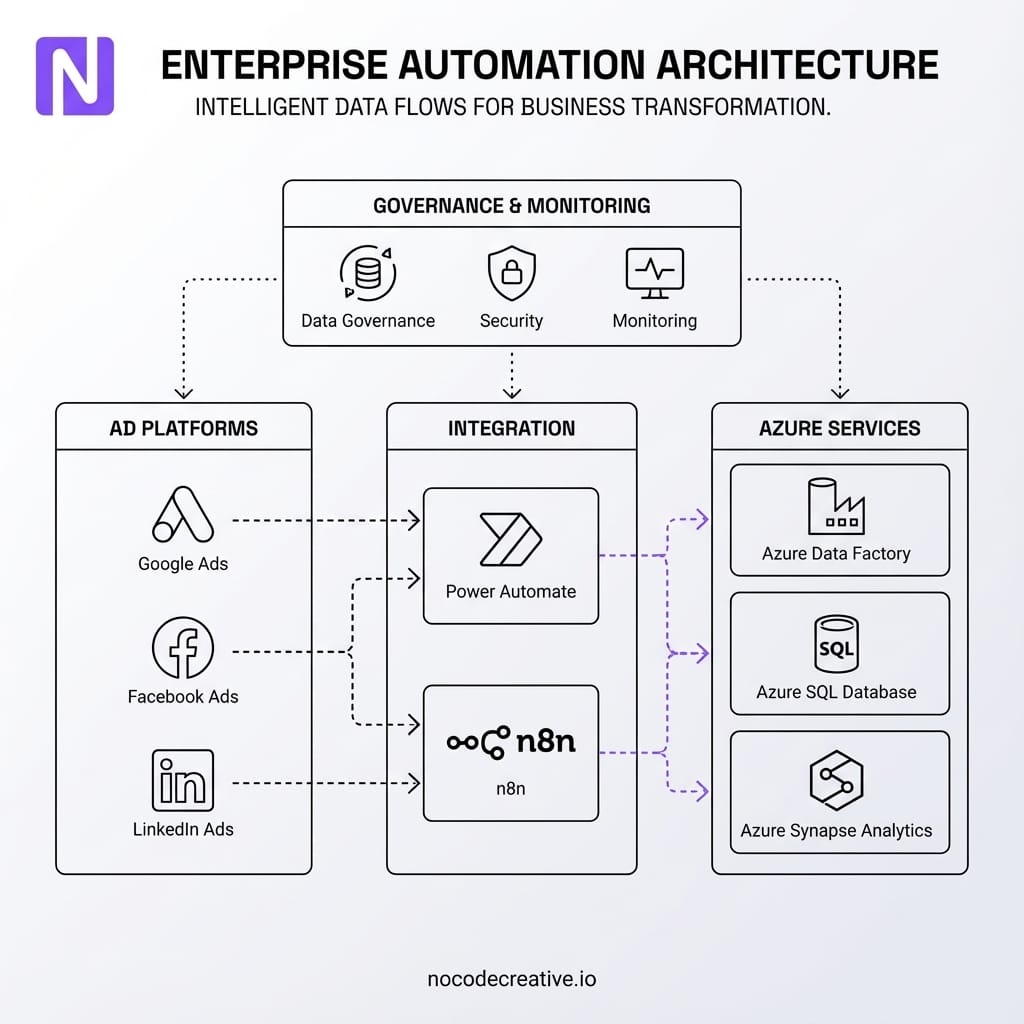
Core architecture: Ad platforms → automation layer → data and CRM
A practical reference architecture looks like this:
- TikTok, Google and Meta campaigns run on Smart+, Performance Max and Advantage+.
- Ad platforms expose performance and lead data through APIs or webhooks.
- n8n or Power Automate sits in the middle to orchestrate data normalisation, lead enrichment, and pushing data into CRMs.
- Azure (or your chosen data stack) stores clean tables for BI tools such as Power BI.
- CRM and downstream systems send confirmed revenue and offline conversions back to ad platforms via API.
Automated reporting and alerting
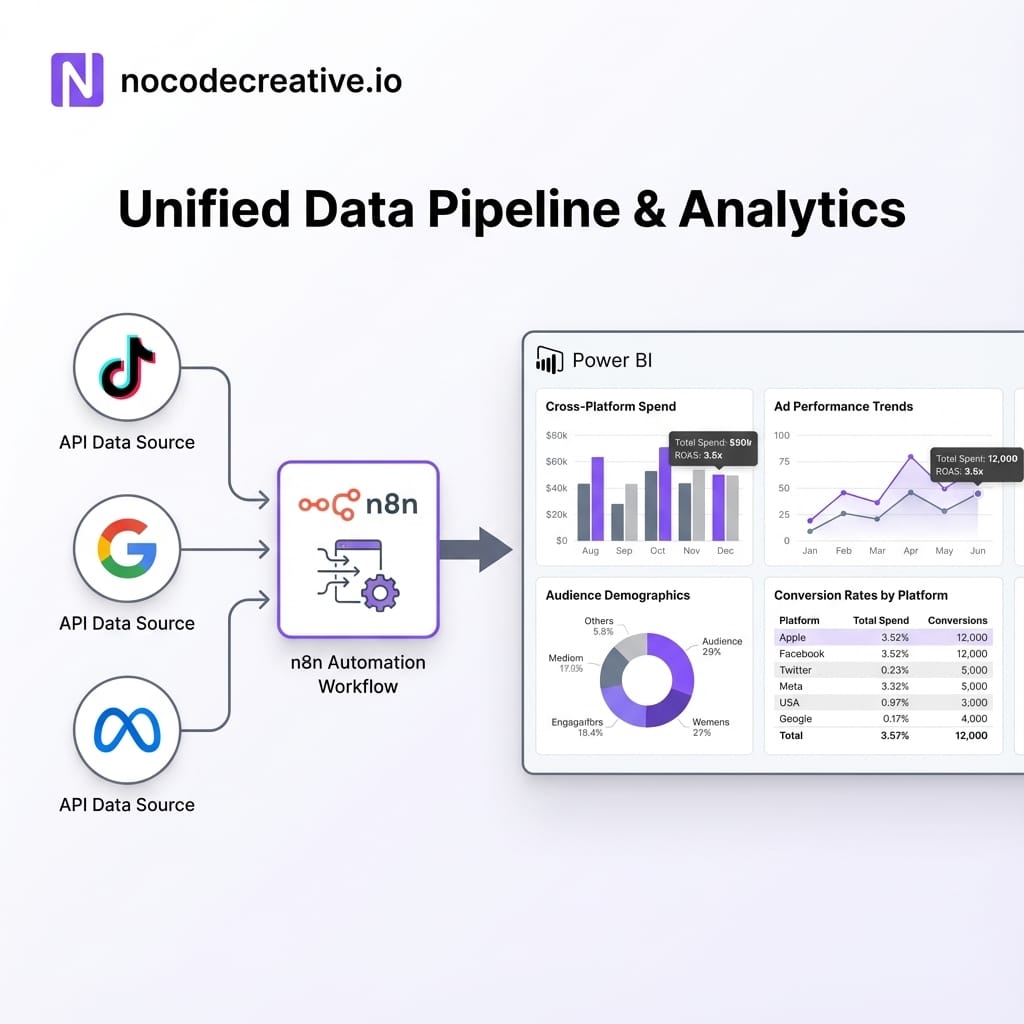
A common frustration with AI campaigns is that they feel like black boxes. You can fix that with an automated reporting pipeline using n8n’s HTTP Request nodes to call marketing APIs on a schedule. By landing that data into Azure SQL or Synapse tables, you can build Power BI models that surface daily dashboards by channel, campaign type, and creative concept.
At nocodecreative, we often wrap this into a wider marketing data and reporting architecture engagement so that finance, marketing and sales leaders are all looking at the same trusted numbers.
Lead capture, enrichment and routing into CRM
If you are running lead gen campaigns, there is no reason any of those leads should touch an inbox manually. A robust workflow captures the lead via webhook, de-duplicates it, enriches it via database, scores it, and routes it to the right salesperson in Dynamics 365, Salesforce or HubSpot—often with a notification in Teams or Slack.
If you want to see this kind of system in practice, our AI-powered lead routing and enrichment services are built around exactly this pattern.
Closed-loop offline conversions
To make AI-powered campaign automation truly work for revenue, you must close the loop. Most platforms maintain APIs specifically for this. Using n8n or Power Automate, you can watch your CRM for "Closed Won" status changes and push those events back to TikTok, Google, or Meta. This trains bidding models on revenue rather than just proxy events.
Implementation blueprint
SMEs: Quick-win setup
For teams that want to move quickly, focus on a minimum viable set of workflows:
- Turn on AI campaign types across major platforms.
- Ensure basic conversion tracking is in place.
- Set up direct lead capture via n8n/Power Automate.
- Wire up simple notifications for high-intent leads.
- Build a lightweight daily performance summary.
Enterprise: Hardening for scale
Larger organisations need a formalised architecture involving:
- Azure data platform as the single source of truth.
- Governed environments with CI/CD and monitoring.
- Custom connectors with managed identities.
- Logging and dead letter queues for data quality.
- Clear data retention and GDPR compliance.
This is typically where our enterprise automation and integration services come in, bringing marketing, RevOps and IT together around a shared, production‑grade design.
Common pitfalls and how automation mitigates them
Starving the algorithm of signal
Low conversion volumes or poor-quality events mean the model is guessing. Closed-loop conversion uploads and better event design are the fix, not another layer of manual bids.
Leads going missing in hand-offs
High-performing lead gen campaigns where half the enquiries quietly die in someone’s inbox. Automated lead routing workflows with n8n or Power Automate remove that leak.
Inconsistent measurement between teams
Marketing, finance and sales reporting on different numbers because exports are stitched together manually. A shared Azure data model and BI layer removes the argument.
Over-constraining campaigns
Stacking so many exclusions into AI campaigns that they never really learn. Thoughtful guardrails plus good reporting let you loosen constraints where performance is strong.
Workflow automation does not replace AI-powered campaign automation. It completes it.
How we help: from experimentation to production-grade
Most teams experimenting with Smart+, Performance Max or Advantage+ feel the shift, but get stuck turning promising early results into something stable. The nocodecreative.io team works with SMEs and mid-market organisations to audit structures, design architectures, build core workflows, and harden them with monitoring.
If you want a sense of what that looks like in real organisations, our AI and automation consulting services outline how we typically engage with marketing, RevOps and IT together.
Ready to build a dependable growth engine?
We specialise in the combination of AI-powered campaign automation, n8n and Microsoft cloud tooling.
References
- Automate, Measure and Maximize: TikTok is building for the future
- TikTok & NewtonX report: Advertisers see AI automation as next growth driver
- Smart+: AI-powered solution to maximize ad campaign results
- Create a Performance Max campaign
- Introducing Advantage+ Shopping Campaigns



Discussion